The System 787: No Clue
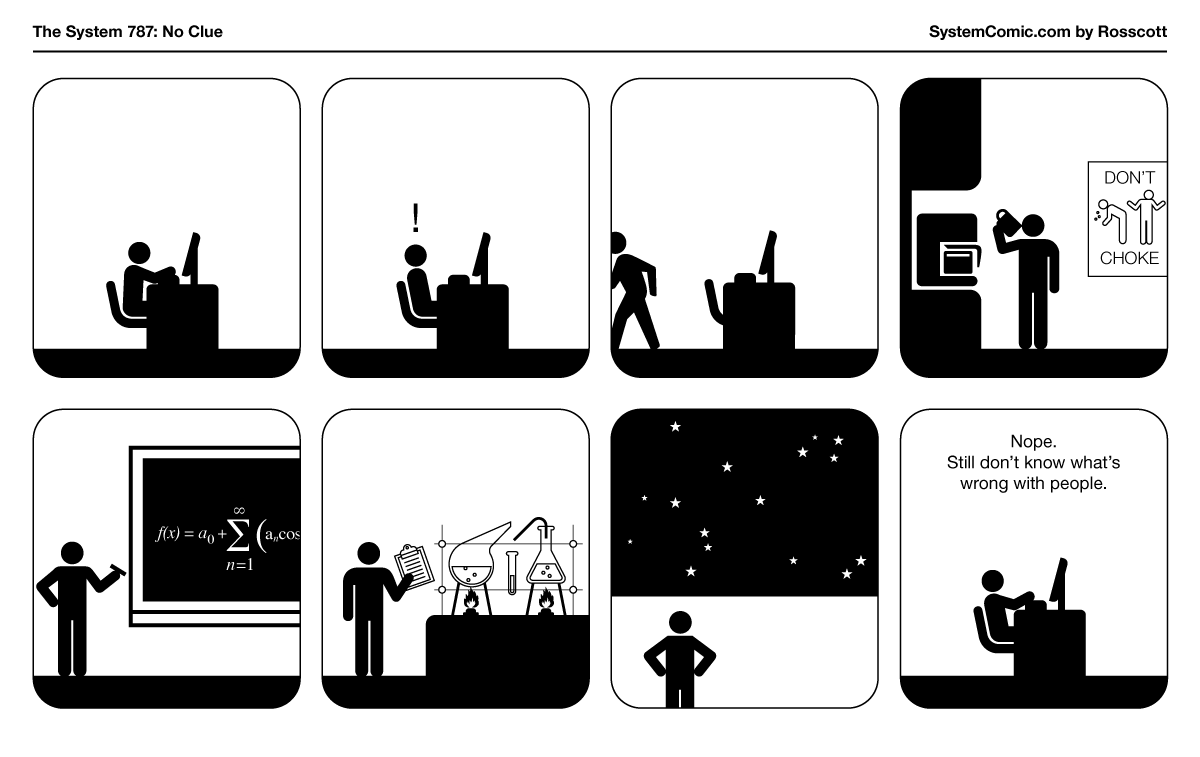
Seemed fitting after last night’s presidential debate.
See More Posts About:
- Image Link Code:
- A link to this post:
- Tweet
- StumbleUpon

The Top 6 Reasons This Infographic Is Just Wrong Enough to Sound Convincing

A little back story:
Zach “Zach Weinersmith” Weiner was looking for someone to help make his idea for this infographic a reality, and I was lucky enough to fit the bill thanks to some work I’d done with College Humor and, yknow, charts. So to be clear, Zach wrote this start to finish, and I did the design work to make it look awesome and real and stuff.
It went up on SMBC Comics earlier this week, and since has showed up on Slate! Oh, and Ezra “BAMF” Klein tweeted:
6 reasons this infographic is wrong, in one infographic: http://t.co/DGwyHiO6HE
— Ezra Klein (@ezraklein) November 7, 2013
Of course if you’d like to buy this chart as a poster, you should click here and make your dreams a reality.
So if you make webcomics and want to make a chart together, apparently you should talk to me.
See More Posts About:
- Image Link Code:
- A link to this post:
- Tweet
- StumbleUpon
The System 632: Furniture Conversions

A pseudo-followup in my ongoing series to “mathify” things:
- Beards turn laziness into awesomeness.
- My body is a filter. Coffee goes in and sarcasm comes out.
- My computer helps me the further I am from it.
- Image Link Code:
- A link to this post:
- Tweet
- StumbleUpon
The System 599: Order of Operations
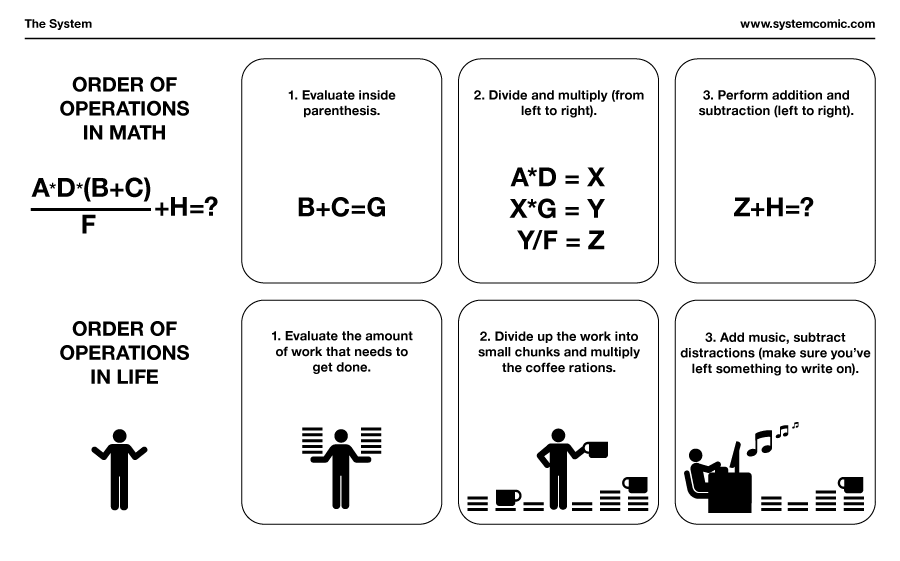
Somewhat related, The System’s Order of Magnitude and of course my Pile System.
Here it is, comic number 599, which means the next one is the big 600! Technically we are past 600, as there’s one I accidently screwed up the number and a few in the archive that don’t really have numbers or don’t fit into the number scheme. Still, exciting to see round numbers.
For those of you that came out to Connecticon this past weekend and said hello at the table OR came to Super Art Fight, thank you so much. It was great to see Rick, ParasitePaladin, Allison, Ray, and all the rest of you who came by to say hi or bought something. And to you newbies, hello. This is my website, hope you like.
To say Connecticon was a success would be an understatement. It was huge. I did the 2nd best sales I’ve ever done at a con and had $0 in costs for the trip, as they were all covered since I was a guest. Not to mention, lots of people came by and said they read the comic which always makes me feel better. No crazy lines or anything, but it’s a wonderful reminder that people actually read this thing I put time into and post on the Internet. The numbers in analytics and the comments I see are written by people who wonder why I didn’t update on Monday, who share it with friends and coworkers, etc. It’s an amazing human connection that I absolutely love, and rejuvenates me until the next show.
Now excuse me while I work on The System Book 1….
See More Posts About:
- Image Link Code:
- A link to this post:
- Tweet
- StumbleUpon
The System 582: Platonic Solids

- Image Link Code:
- A link to this post:
- Tweet
- StumbleUpon
The System 576: Mean

Math jokes. Right?
This is based on the Mean Chocolate Chip Cookies I saw a while back, and thought about again when I was baking muffins yesterday.
See More Posts About:
- Image Link Code:
- A link to this post:
- Tweet
- StumbleUpon
The System 563: Ways Not To Defend
- Image Link Code:
- A link to this post:
- Tweet
- StumbleUpon
The System 430: Book Title Modulation
Remember as I said Saturday, any purchases of original prints / posters through the end of this month will have money donated to breast cancer research! Especially the last comic on breasts and typefaces. Just place any order from http://www.hilariawesome.com/ for any comic print and I’ll do the rest. At the end of the month I’ll post a tally of how it goes.
Speaking of Saturday, I didn’t get to a comic on Friday but did post it on Saturday. If you didn’t get a chance to see it, I recommend it. You should check it out here.
- Image Link Code:
- A link to this post:
- Tweet
- StumbleUpon
The System 372: Boltzmann

Greetings, Slashdot-ers!
We here at Rosscott, Inc. glady welcome our new Slashdot overlords. Seriously though, look around! There’s plenty of comics in the veins of flying cars, charts, and other things that I would consider Slashdot-approved. If you really love the comic (this one, or in general) there’s even the HilariAwesome store where I sell prints of the comic, shirts and hopefully more soon. Finally, so you never have to actually look at the site again, there’s an RoSS feed of the site. Subscribe.
After 140 years, the Boltzmann Equation has been solved. the Boltzmann Equation has been verified, “by solving the equation for all types of collisions, including the type of small-angle collision never previously included in the analysis.” (Thanks, Heath!) Sure, it’s about gaseous behavior (heh) but I’m guessing any guys that can solve that might as well be hooking up a flying car. Why they didn’t just look in the back of the book for the answer to the Boltzmann Equation decades ago is beyond me.
Site Update: There’s now alt texts with comics. Only the last few, but I may go back and add some here and there, just to keep you guys on your toes. Oh, and the comic images? Just click ’em and it’ll take you through the archive. Quick and easy!
See More Posts About:
- Image Link Code:
- A link to this post:
- Tweet
- StumbleUpon
Systemic Action: Make it Mathy!
Yesterday’s comic, The System 333: Full Gadget Ratio has been doing quite well for itself. It made it to the front of Reddit for a hot second, has spread around pretty well on Twitter, etc. However, a bunch of people more mathy than I, thinking I’m secretly trying to be XKCD (hint: XKCD has yet to do a comic about crop marks and bleed), are having some trouble with the equation. Fair, since I spend too much time on the graphic and little on making the equation work. Case in point:
Why take so much time on the graphic only to have such a poorly thought out equation?
I’m not normally one to obsess over others’ comments on the comic, but they have a valid point. Systemics, let’s give this chart an equation to be proud of! Given the variables at hand, help me come up with something better. Use whatever units of measurement you feel appropriate and all the information at hand, and post them here in the comments. I’ll update this chart and give credit where due the best I can. In fact, I’ll be picking at random one of the people who helps in the comments to get a FREE PRINT of this comic from our store, HilariAwesome.com!
UPDATE: It’s been a while, I know. Congrats to Systemic Harris who submitted an awesome entry that will be reflected in the original post, and will also be receiving a print of this comic! Check out the original comic to see the mathy update.
See More Posts About:
- A link to this post:
- Tweet
- StumbleUpon
Comments: