The System 350: The Cycle of (Time) Suck

UPDATE: You can even buy this as a print from my store!
Today’s comic was largely inspired by two things:
- Loldwell’s awesome comic on his cycle known as “An Earful of Nothing”.
- The entirety of my professional career.
If you haven’t checked out Loldwell yet, you really need to. I linked to it a while back and it is always worth the read. He also does comics / illustrations for College Humor, but they don’t need a link cuz they are doing juuuuust fine.
You know who COULD use your help? ME! I could still use your help by preordering the new BEARD SHIRTS. They are only $17.00 plus shipping and preordering helps me figure out a lot about how many to order. I’m running preorder through the end of this week so be sure to PREORDER NOW!
- Image Link Code:
- A link to this post:
- Tweet
- StumbleUpon

The System 340: Why We Need Charts

My brother says this is begging for the Heisenberg Uncertainty Principle, but that would ignore all my friends in the world of social sciences. Instead, the Observer Effect works just fine, which gets at the root of the issue.
UPDATE: Systemic MikeASchneider has alerted me to the similarities between this comic and one done by XKCD. No piracy was intended, and I maintain that this one is prettier and better kerned. While I’m a fan of XKCD, I can’t say I’ve read every one. Great minds think alike, I suppose? For those wondering where all the graphic design jokes have gone, stay tuned. They aren’t far off.
See More Posts About:
- Image Link Code:
- A link to this post:
- Tweet
- StumbleUpon
The System 333: Full Gadget Ratio

UPDATE-UPDATE: I know what you’re thinking. The equation is crap! Here’s how you can help me fix it!
Everything you need to know to calculate the true size of the gadgets you carry. There are way more factors than you may have considered. I invite you to calculate yours, and post in the comments. Use standard metric system for all measurements. As for Planck’s Apple Constant (based on his original work on Planck’s Constant), everyone knows that’s a physical constant used to describe the size of the smallest iPod available used in the pricing of running arm bands and quantum mechanics.
Systemic Harris has helped us better define the Full Gadget Ratio, with an equation that has now been reflected in the above image. Here’s his breakdown:
On the FGR of Mobile Devices:
Clearly, FGR should be a measure of how bulky/inconvenient the object is, amortized over how useful it is. So:
FGR, the base term at first glance should be affine in S,A,B, as these all contribute more or less additively to bulkiness. T is an issue, though for now we can add it in as well. I see lots of people use S*T or some such, which is clearly not right, though my S+T isn’t much better. Really, the question is whether S is a volume, or the bulkiest dimension, or maybe, it’s the largest face divided by the opposite direction (screen size divided by thickness, say). The question is whether S should be a measure of useful dimensions vs. non-useful dimension, like the latter, or a general matter of how bulky something is to carry around, so a simple volume, or the bulkiest dimension. The interaction w/ T then plays into that. Not sure the best way to handle it. The most accurate would be to break S into the three dimensions and apply T directly, recomputing the volume, but that will complicate the device enormously. So for now we leave it linear.
If a device is twice as useful, it’s clearly functionally half as bulky, so divide by U.
Higher H makes it more useful, but how? On the one hand, H should essentially contribute to higher U, as you can’t use it if the battery is dead, so will use it more. But only past a point, as if it can do, say, 24 or 48 hours w/out recharge, it’s not an inconvenience to recharge every so often. So replacing 1/U by (1 + 1/H)/U is good for bulkiness, as low H decreases effective usefulness a lot, but past a point high H is diminishing returns.
Additionally, though, H plays off against A, as the longer it lasts w/out power the less you need to carry the power adapter around. So perhaps replace the A term by A/H, that is, the bulk of the adaptors is reduced by you maybe not needing to carry them around. Really this should be a threshold effect of some kind, though, where either you are carrying the adaptors around or you aren’t, so maybe multiply A by an appropriate shifted Heaviside function of H. Still, the linear approximation is ok for now. And of course, that you rolled chargers & adapters into the same category muddles the issue.
The worry factor increases bulkiness, presumably linearly. But, if newer versions are out, you don’t mind it breaking as much because you want to buy the new one. So there should be a W/N factor in there (where obviously we must count N as the number of generations at least as new as this one, to avoid division by 0). Again, though once it is old enough you don’t worry at all, but this shouldn’t go to 0, so it should be (1+ W/N).
And the constant should definitely be used as a multiplier, to get the units (whatever they are) to come out right.
So maybe:FGR = (S + T + A/H + B) * (1+1/H)/U * (1 + W/N) * h, or reordered to look a little nicer
FGR = h(1+W/N)(1+1/H)(S+T+A/H+B)/U
This is why I outsource the really mathy stuff. It’s just easier that way.
UPDATE: As always, if you want a print of this comic (or any comic), they are all only $10 at our online store, Hilariawesome.com!
See More Posts About:
- Image Link Code:
- A link to this post:
- Tweet
- StumbleUpon
The System 328: Graphic Info
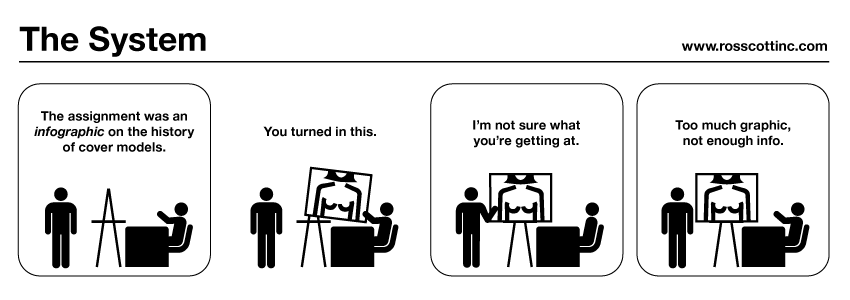
If you like this one, check out my previous comics with infographics, charts and graphs, and one on boobs.
See More Posts About:
- Image Link Code:
- A link to this post:
- Tweet
- StumbleUpon
The System 316: Internet Advocacy
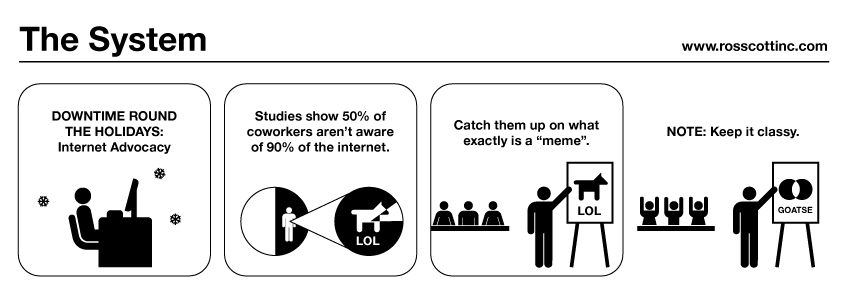
Do your part this year. Help spread the word about what is awesome on the internet. If that includes this comic, so be it.
Btw Mom, and I’m NOT kidding around about this, just let this one go. Don’t ask me about it and whatever you do, DO NOT GOOGLE IT.
- Image Link Code:
- A link to this post:
- Tweet
- StumbleUpon
What Kind of Artist Are You?

Carter and Paul over at Crooked Gremlins posted this chart, claiming they are both on opposite sides of the spectrum. I’m ashamed to say where I am on it. Where are you?
Btw the creator of this chart is a comic artist / illustrator / assumedly graphic designer and I spent too long looking through the archive. It’s now in not only the comics I read, but the 1st set right after lunch. High praise indeed. His site here.
PS If in some way Caldwell Tanner comes across this and is in any way inclined to send me a Falcon Lunch shirt, that would be great thanks.
See More Posts About:
- A link to this post:
- Tweet
- StumbleUpon
The System 281: Singletasking
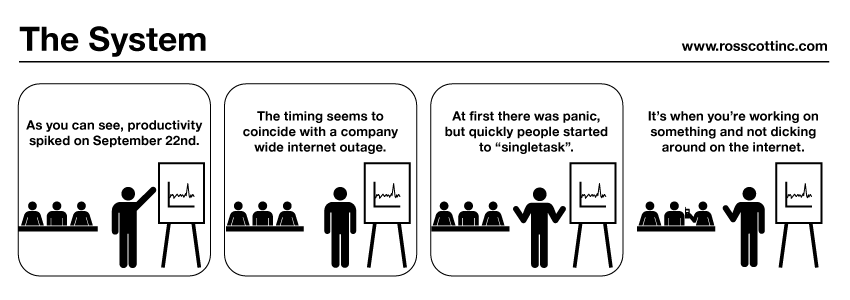
Do you ever singletask anymore?
UPDATE: Thanks to everyone who followed Leo Laporte here! If you’re new to the comic, check out the first comic. Or maybe the other comics with rules and terms, all along similar lines. Or the comic archive. Oh, and like Leo, I’m also on Twitter.
See More Posts About:
- Image Link Code:
- A link to this post:
- Tweet
- StumbleUpon
The System 264
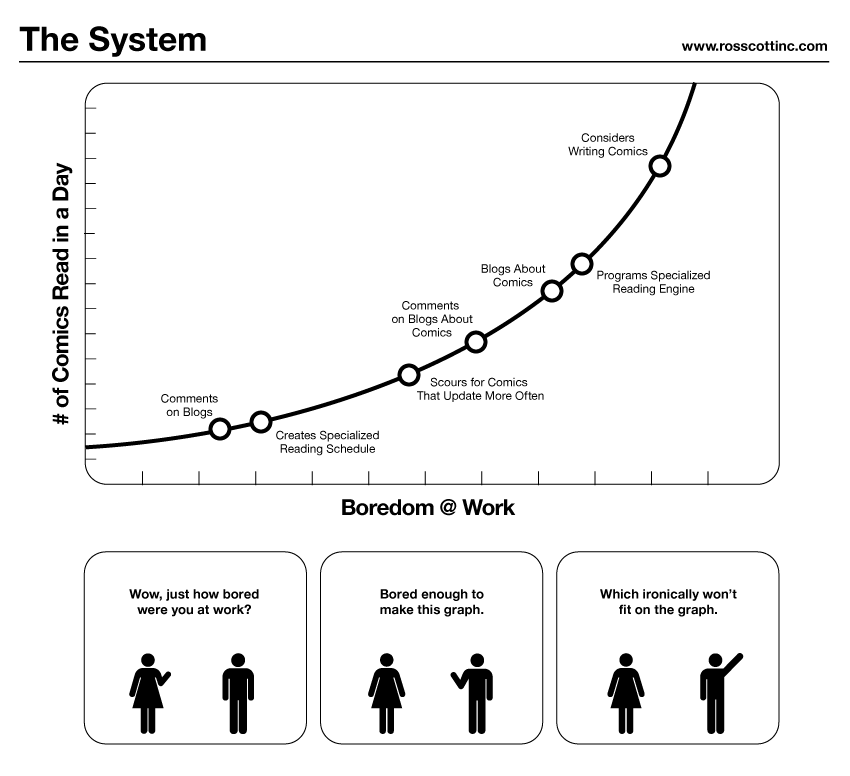
I looked around and through all the “chart jokes” I could find, I didn’t find one like this. Wonder where I would chart, considering I made the graph and the comic about the graph? For that matter, where are YOU on the graph?
- Image Link Code:
- A link to this post:
- Tweet
- StumbleUpon
Comments: